
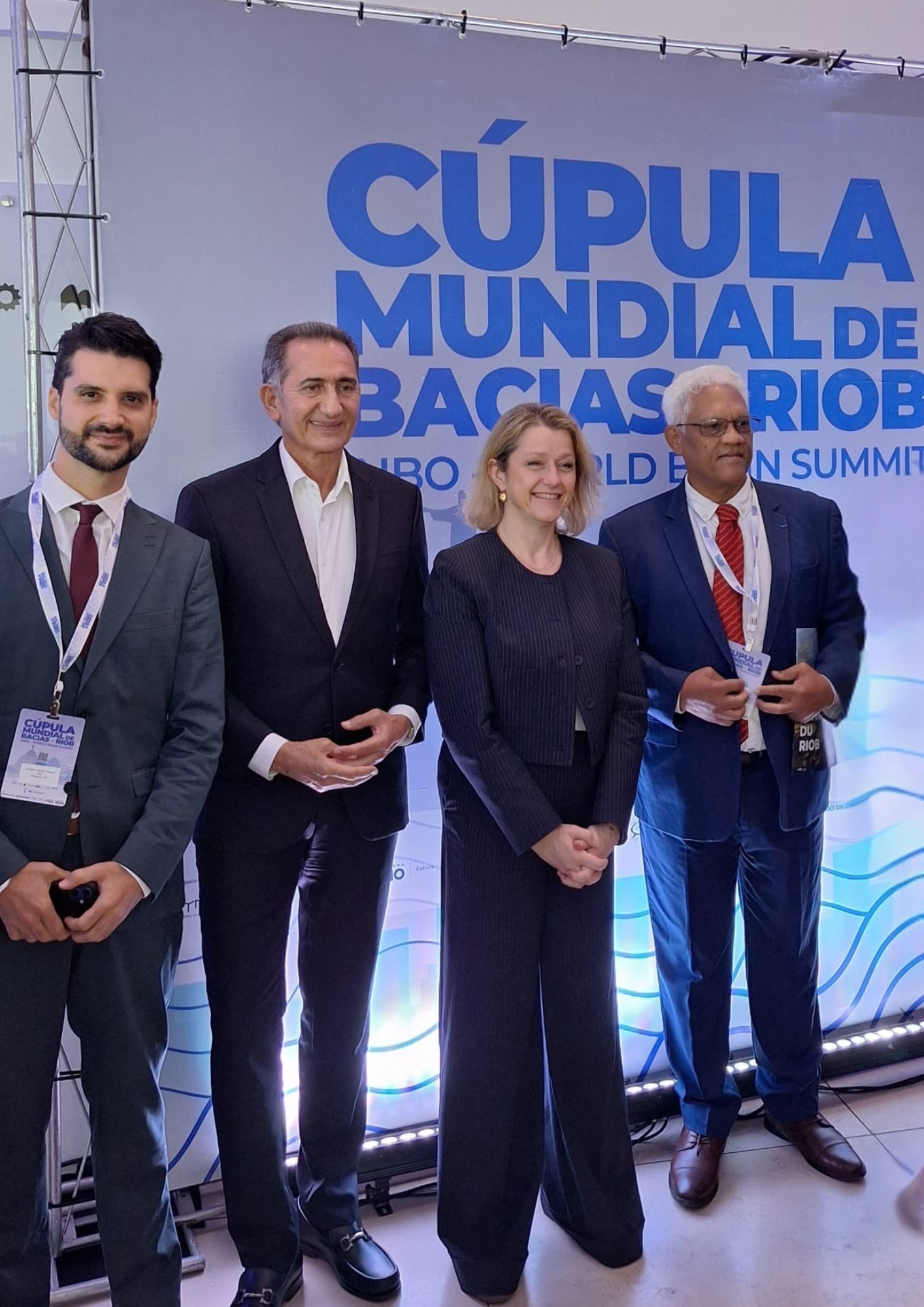
From June 16 to 19, 2026, the BIO-PLATEAUX project participated in the International Network of Basin Organizations (INBO) Watersheds Summit, held in Rio de Janeiro, Brazil. This international event brought together representatives from basin organizations, public authorities, and experts from around the world to discuss the challenges of integrated water resources management in the face of climate change, biodiversity conservation, and sustainable regional development. During this event, the Network’s presidency was transferred from France to Brazil. It will be held by the Ministry of Regional Development, in conjunction with the National Water Agency (ANA).
French Guiana was represented by Patrick Lecante, Chair of the French Guiana Water and Biodiversity Committee, and Thibault Lechat Vega, Vice Chair of the Territorial Collectivity of French Guiana (CTG), accompanied by the BIO-PLATEAUX project team.
The Maroni and Oyapock Rivers at the Heart of Discussions
Through a series of institutional meetings and working sessions, the French Guiana delegation presented the challenges facing the Maroni and Oyapock river basins, two transboundary rivers shared by French Guiana, Suriname, and Brazil.
The discussions highlighted the challenges shared by these territories: biodiversity conservation, improving hydrological knowledge, water quality, development of water uses, adaptation to climate change, and strengthening governance. They also underscored the importance of coordinated management at the watershed level, a founding principle of INBO.
BIO-PLATEAUX’s Progress Highlighted
The Summit provided an opportunity to present the main results achieved by BIO-PLATEAUX in support of cross-border cooperation between French Guiana, Suriname, and the Brazilian state of Amapá, notably:
- strengthening political and technical dialogue among the three territories;
- progress toward the creation of a European Grouping of Territorial Cooperation (EGTC) for the Maroni River basin;
- progress in the Franco-Brazilian dialogue on the Oyapock River, with Brazil set to sign, a few days later (during the meeting of foreign ministers scheduled for July 1), the Declaration of Intent regarding the creation of a dialogue forum for the integrated management of the watershed;
- the development of shared tools for knowledge management, hydrological monitoring, and decision support, drawing on field observations, satellite data, and modeling;
- awareness-raising, outreach, and experience-sharing initiatives carried out with stakeholders in the three countries.
Enhanced International Visibility
This participation has also facilitated new exchanges with river basin organizations, water agencies, and international partners.
Sharing experiences regarding transboundary river basins located on different continents has opened up new avenues for cooperation.
By bringing the challenges facing the Maroni and Oyapock rivers to the international stage, BIO-PLATEAUX reaffirms its role as a catalyst for cross-border cooperation and helps promote the expertise developed among French Guiana, Suriname, and Brazil in the field of integrated water resources management.
The International Office for Water serves as the permanent technical secretariat of INBO.